
Modelled on GreenComp’s logic – moving from inner dispositions outward through understanding, imagination, and finally to action – here is a proposed framework to support the development of Learning and Teaching Packages (LTPs).
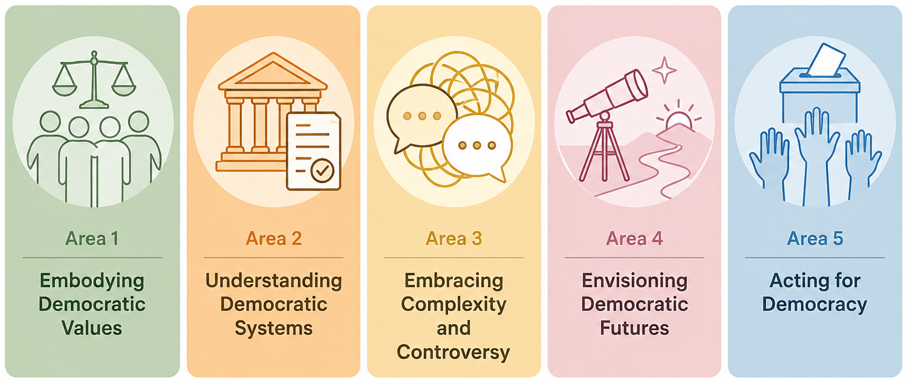
Description of the five areas
Area 1 – Embodying Democratic Values
The foundation. Before citizens can act democratically, they must be democratic — in their relationships, their institutions, and their self-understanding. This area covers the internalized commitment to human dignity, equality, freedom, the rule of law, and pluralism. It is about character and disposition as much as knowledge: cultivating intellectual humility, a tolerance for disagreement, and genuine respect for others’ right to hold and express different views. Democracy starts not in the polling booth but in how people treat each other.
Area 2 – Understanding Democratic Systems
Citizens cannot defend or transform what they do not understand. This area builds structural and historical literacy about how democratic systems work — constitutions, parliaments, courts, elections, rights frameworks, and the EU’s own architecture — alongside honest engagement with how those systems can fail, be captured, or erode. It includes understanding the difference between liberal democracy and its competitors, and why that difference matters.
Area 3 – Embracing Complexity and Controversy
Democratic life is irreducibly messy. This area develops the capacity to sit with genuine disagreement, to resist the pull of simple narratives, and to engage productively with contested political, social, and ethical questions without retreating into tribalism or false certainty. It encompasses media and information literacy, the ability to distinguish legitimate controversy from manufactured disinformation, and the epistemic courage to change one’s mind when evidence demands it.
Area 4 – Envisioning Democratic Futures
Democracies are not fixed — they are always being remade. This area cultivates the political imagination: the ability to envision how institutions could be more just, more inclusive, or more responsive; to think creatively about reform; and to connect personal hopes and values to collective political possibility. It draws on utopian thinking as a civic resource, while grounding aspiration in realistic understanding of how change happens. Without this, citizenship becomes merely reactive.
Area 5 – Acting for Democracy
Knowledge and values without action leave democracy hollow. This area encompasses the full repertoire of democratic participation — voting, deliberating, organising, advocating, volunteering, protesting, standing for office — and builds the practical skills, confidence, and sense of agency that make action possible. Critically, it attends to the barriers to participation (class, ethnicity, geography, disability) and treats removing those barriers as itself a democratic task. Citizens act not only within democratic systems but, when necessary, on them.
THE LOGIC OF THE FRAMEWORK
The five areas move from the inside out: from who you are (Area 1), through what you understand (Areas 2 & 3), to what you can imagine (Area 4), and finally to what you do (Area 5). They are mutually reinforcing – action without values becomes opportunism; values without structural understanding become naive; understanding without imagination becomes fatalism. The framework only works as a whole.