[by Polytéchnico de Santarém]
In recent years, students in the Bachelor’s Degree in Basic Education of Santarém Polytechnic (Portugal) have been challenged to think, act, and transform their community through Environmental Citizenship Education (ECE). The Learn to Act project emerged from the conviction that initial teacher education is a privileged space for developing critical, ethical, and participatory competences — essential for addressing today’s socio‑environmental challenges and strengthening democratic citizenship.
International literature highlights this urgency. Hadjichambis et al. (2020) argue that environmental citizenship requires articulating scientific knowledge, critical reflection, and civic participation, preparing citizens capable of informed and transformative action. Georgiou et al. (2021) reinforce that environmental education must actively engage students in analysing and solving socio‑environmental problems, developing competences essential for democratic societies. The European Sustainability Competence Framework (Bianchi et al., 2022) also stresses the need to educate citizens who act responsibly, with systemic thinking and ethical commitment.
Between February and June 2026, students were challenged to assume the role of change agents, following the six stages of the ECE pedagogical approach: investigation, action planning, civic participation, networking, sustainability, and evaluation‑reflection. The process began with the analysis of real environmental issues, such as air pollution or biodiversity loss, using scientific sources and constructing Controversy Maps. This enabled them to understand the complexity of socio‑environmental challenges and recognise the diversity of perspectives involved — an essential step for democratic practice.
Intervention in real‑world contexts was one of the most significant moments. In schools, kindergartens, after‑school programmes, and other community settings chosen by each group, students implemented educational and awareness‑raising activities that promoted critical thinking, participation, and shared responsibility. School gardens, insect hotels, STEAM workshops, debates on environmental justice, and hands‑on activities brought science, citizenship, and transformative action closer together.
These results align with the project’s central objectives: developing innovative educational practices in sustainability; integrating environmental citizenship into higher education; empowering future professionals to become agents of change; and strengthening collaborative networks. All of this is consistent with international frameworks such as the SDGs (United Nations, 2019), the European Key Competences for Lifelong Learning (European Commission, 2019), and UNESCO recommendations (2017, 2021), which recognise education as a driver of social transformation.
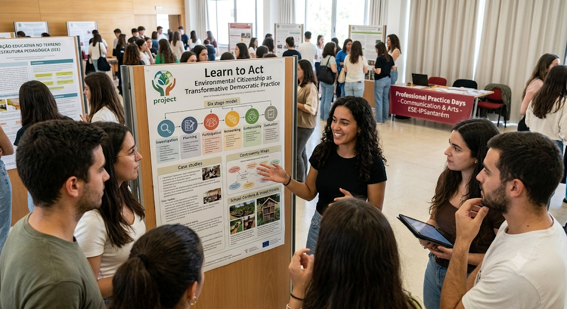
A particularly relevant aspect of this journey was the dissemination and public sharing of practices, culminating in the presentation of posters at the Professional Practice Days – Communication & Arts, held on 1 and 2 June 2026. This moment allowed students to communicate their processes, justify decisions, engage in dialogue with peers, lecturers, and external partners, and reflect on the impact of their actions. More than a showcase, it was an exercise in democratic citizenship: opening the educational process to the community, making learning visible, and assuming the social responsibility of their interventions.